
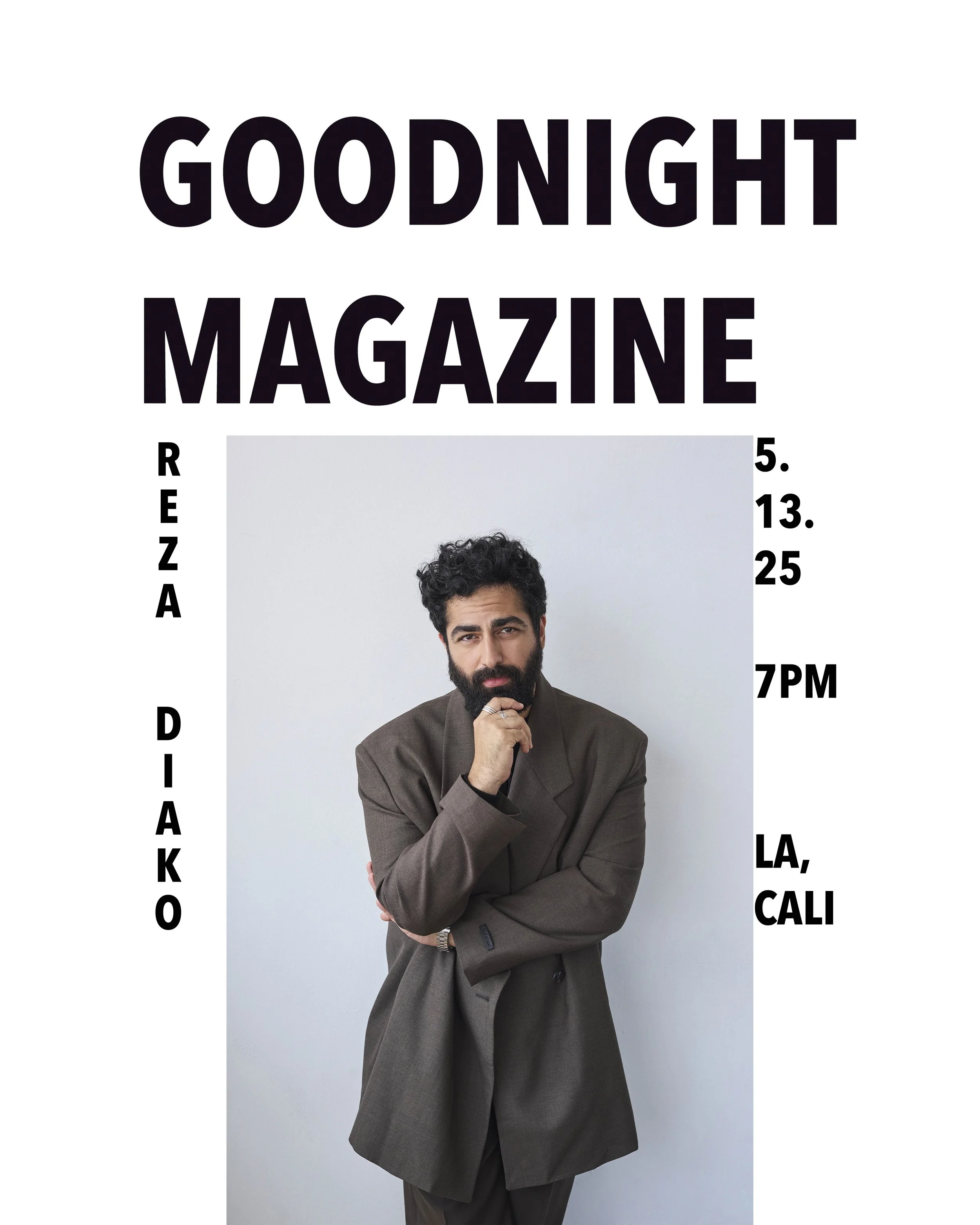
Reza Diako
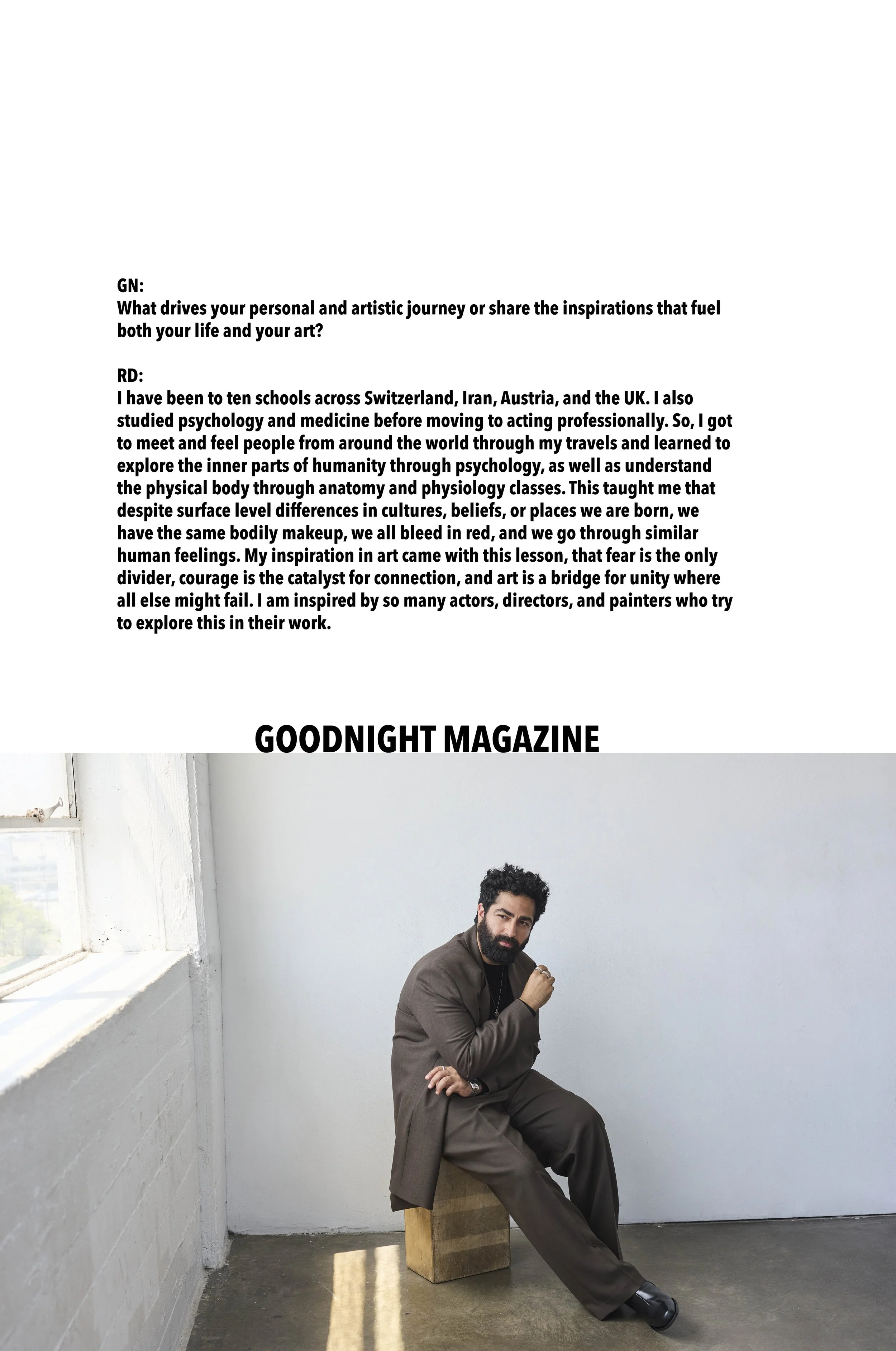
GN: What drives your personal and artistic journey or share the inspirations that fuel both your life and your art?
RD: I have been to ten schools across Switzerland, Iran, Austria, and UK. I also studied psychology and medicine before moving to acting professionally. So, I got to meet and feel people from around the world through my travels and learned to explore the inner parts of humanity through psychology, as well as understand the physical body through anatomy and physiology classes. This taught me that despite surface level differences in cultures, beliefs, or places we are born, we have the same bodily make up, we all bleed in red, and we go through similar human feelings. My inspiration in art came with this lesson, that fear is the only divider, courage is the catalyst for connection, and art is a bridge for unity where all else might fail. I am inspired by so many actors, directors, and painters who try to explore this in their work.
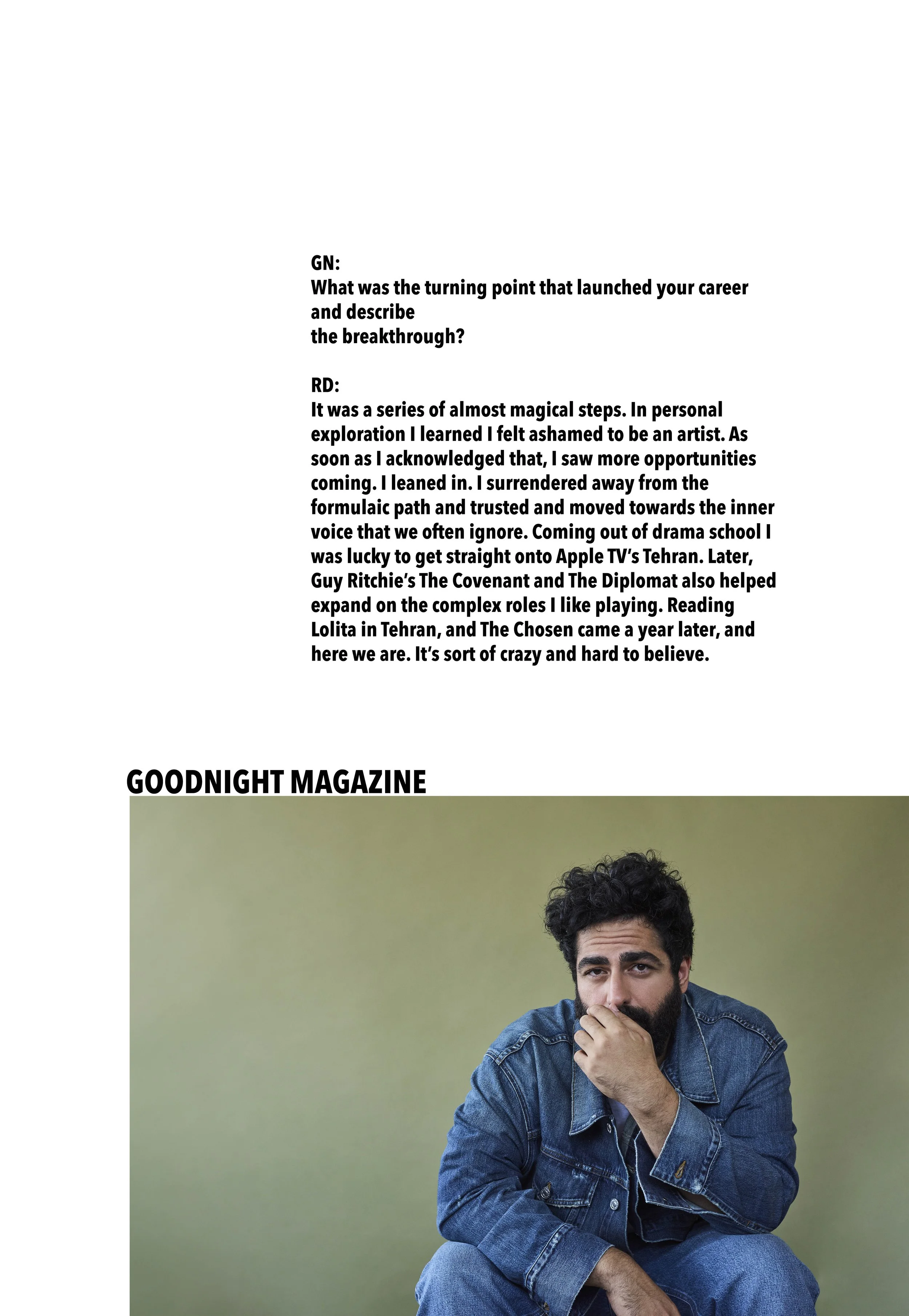
GN: What was the turning point that launched your career and describe the breakthrough?
RD: It was a series of almost magical steps. In personal exploration I learned I felt ashamed to be an artist. As soon as I acknowledged that, I saw more opportunities coming. I leaned in. I surrendered away from the formulaic path and trusted and moved towards the inner voice that we often ignore. Coming out of drama school I was lucky to get straight onto Apple TV’s Tehran. Later, Guy Ritchie’s The Covenant and The Diplomat also helped expand on the complex roles I like playing. Reading Lolita in Tehran, and The Chosen came a year later, and here we are. It’s sort of crazy and hard to believe.
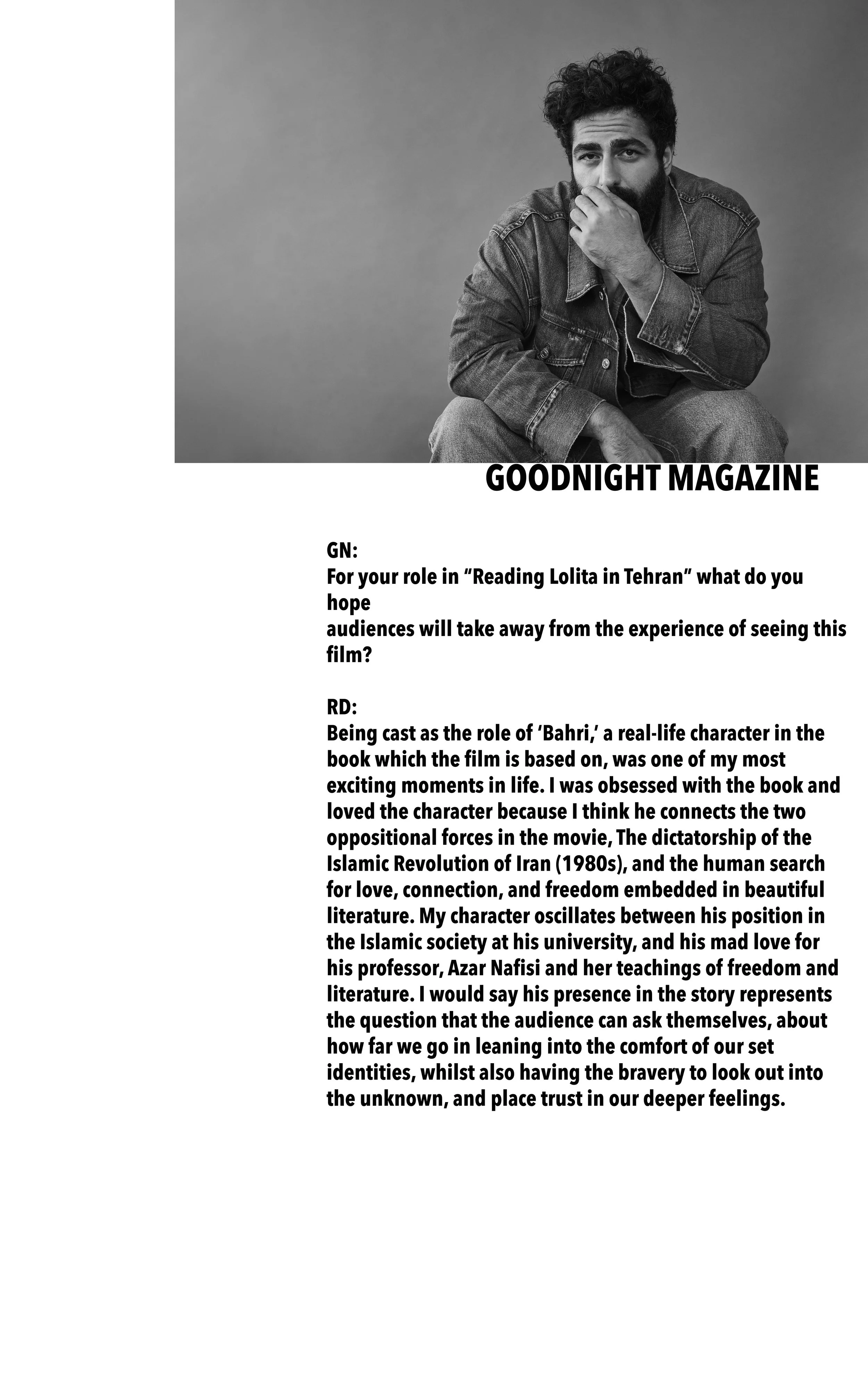
GN: For your role in “Reading Lolita in Tehran” what do you hope audiences will take away from the experience of seeing this film?
RD: Being cast as the role of ‘Bahri,’ a real-life character in the book which the film is based on, was one of my most exciting moments in life. I was obsessed with the book and loved the character because I think he connects the two oppositional forces in the movie, The dictatorship of the Islamic Revolution of Iran (1980s), and the human search for love, connection, and freedom embedded in beautiful literature. My character oscillates between his position in the Islamic society at his university, and his mad love for his professor, Azar Nafisi and her teachings of freedom and literature. I would say his presence in the story represents the question that the audience can ask themselves, about how far we go in leaning into the comfort of our set identities, whilst also having the bravery to look out into the unknown, and place trust in our deeper feelings.
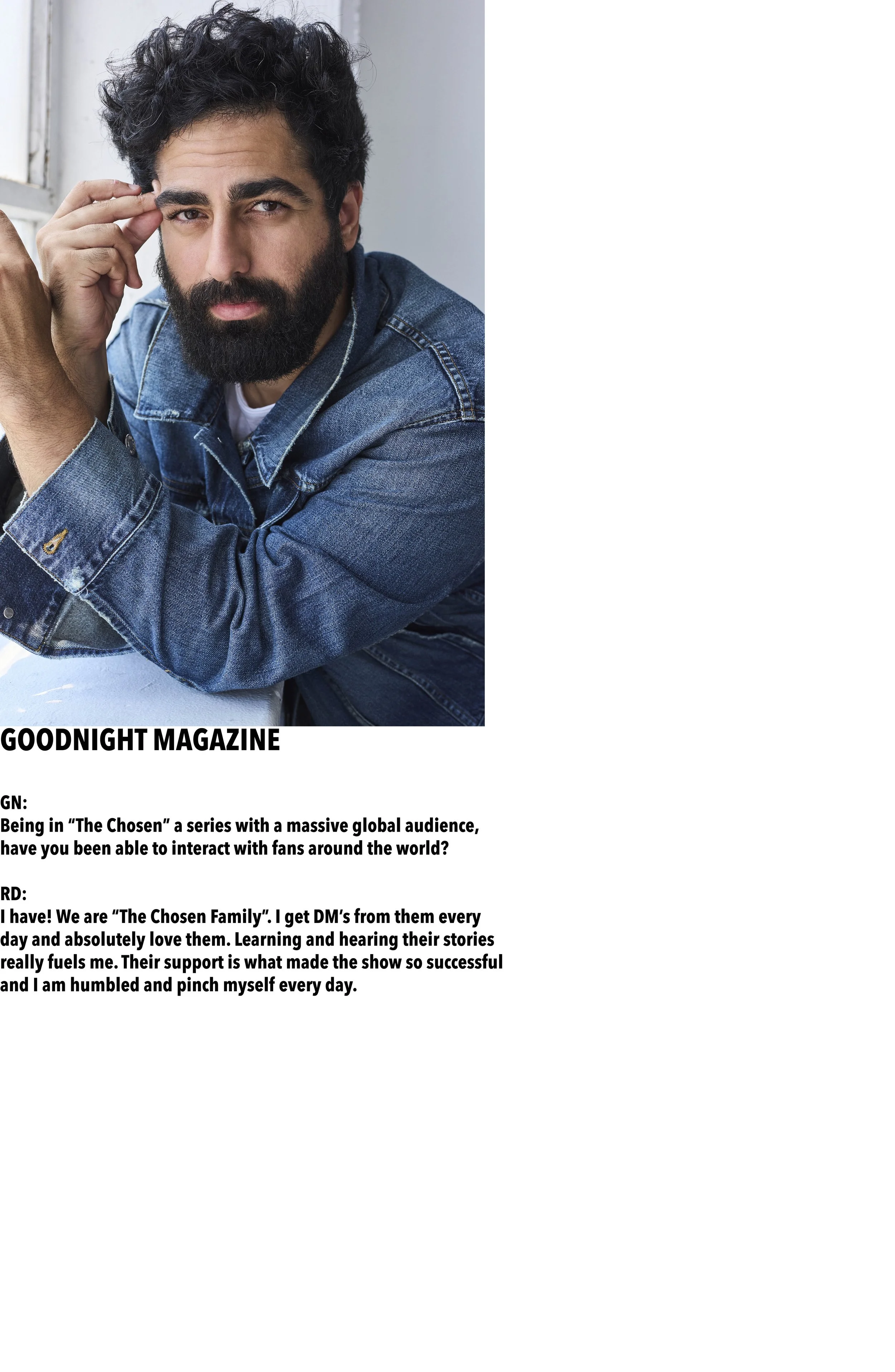
GN: Being in “The Chosen” a series with a massive global audience, have you been able to interact with fans around the world?
RD: I have! We are “The Chosen Family”. I get DM’s from them every day and absolutely love them. Learning and hearing their stories really fuels me. Their support is what made the show so successful and I am humbled and pinch myself every day.
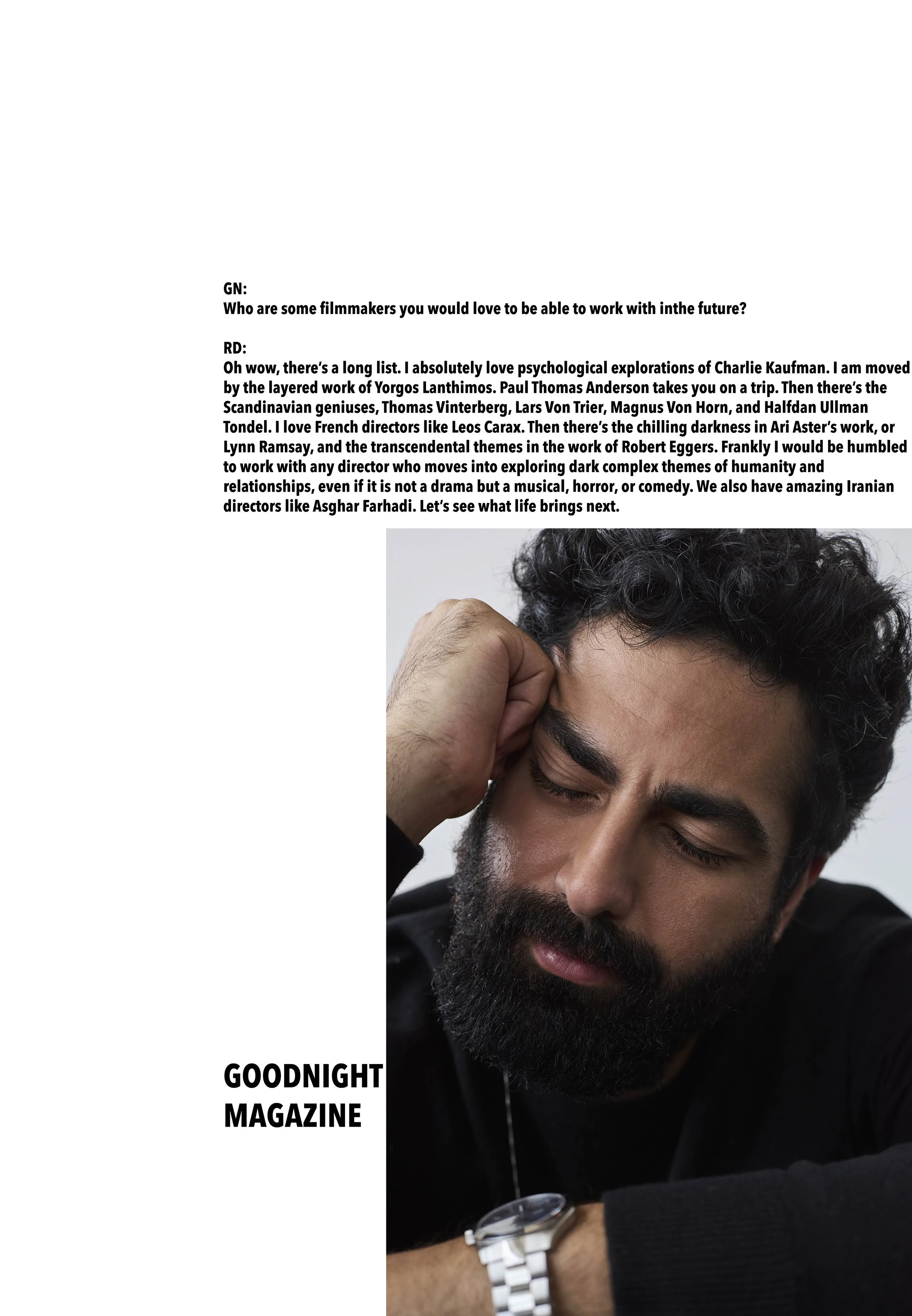
GN: Who are some filmmakers you would love to be able to work with in the future?
RD: Oh wow, there’s a long list. I absolutely love psychological explorations of Charlie Kaufman. I am moved by the layered work of Yorgos Lanthimos. Paul Thomas Anderson takes you on a trip. Then there’s the Scandinavian geniuses, Thomas Vinterberg, Lars Von Trier, Magnus Von Horn, and Halfdan Ullman Tondel. I love French directors like Leos Carax. Then there’s the chilling darkness in Ari Aster’s work, or Lynn Ramsay, and the transcendental themes in the work of Robert Eggers. Frankly I would be humbled to work with any director who moves into exploring dark complex themes of humanity and relationships, even if it is not a drama but a musical, horror, or comedy. We also have amazing Iranian directors like Asghar Farhadi. Let’s see what life brings next.
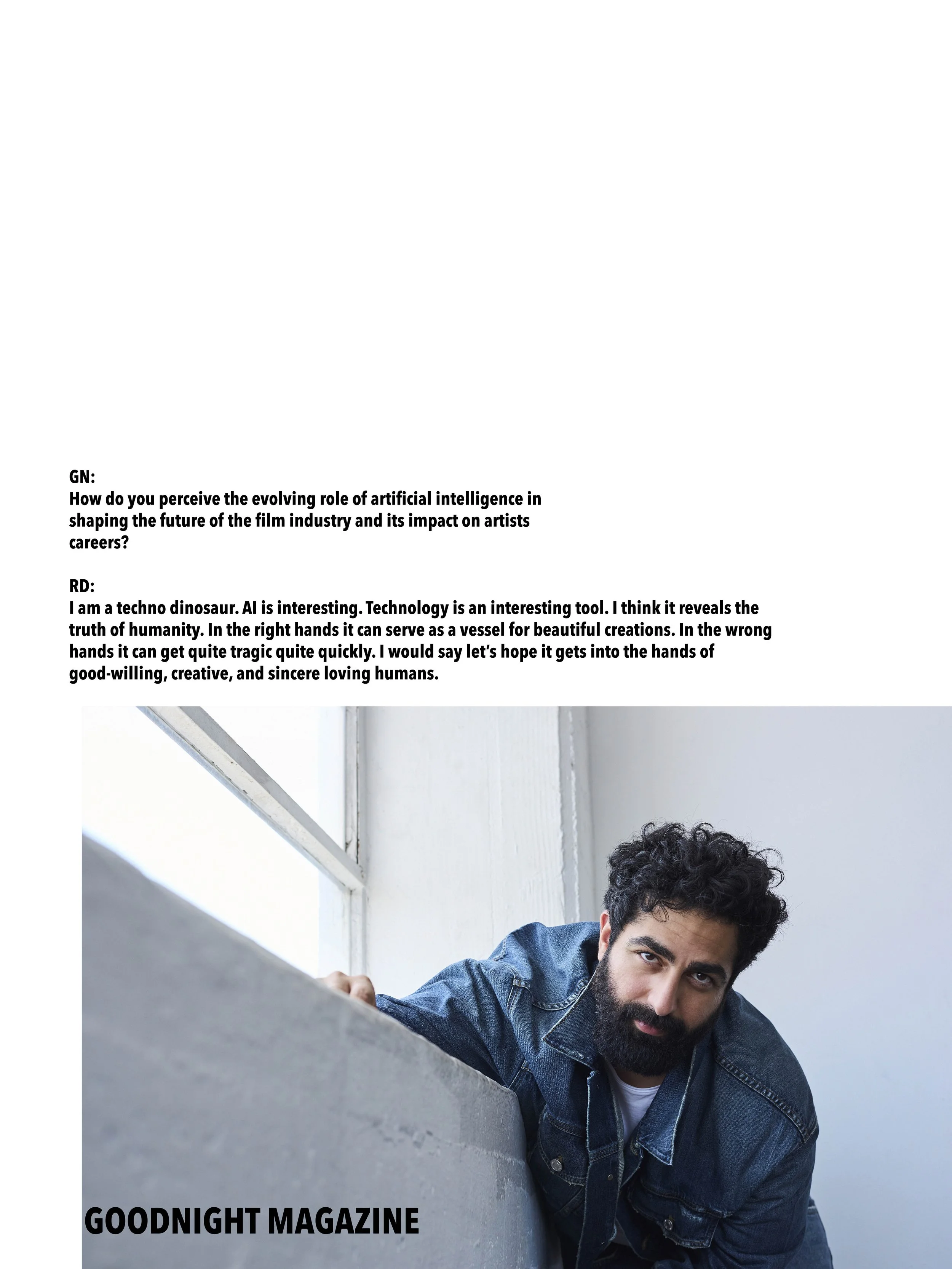
GN: How do you perceive the evolving role of artificial intelligence in shaping the future of the film industry and its impact on artists careers?
RD: I am a techno dinosaur. AI is interesting. Technology is an interesting tool. I think it reveals the truth of humanity. In the right hands in can serve as a vessel for beautiful creations. In the wrong hands it can get quite tragic quite quickly. I would say let’s hope it gets into the hands of good-willing, creative, and sincere loving humans.
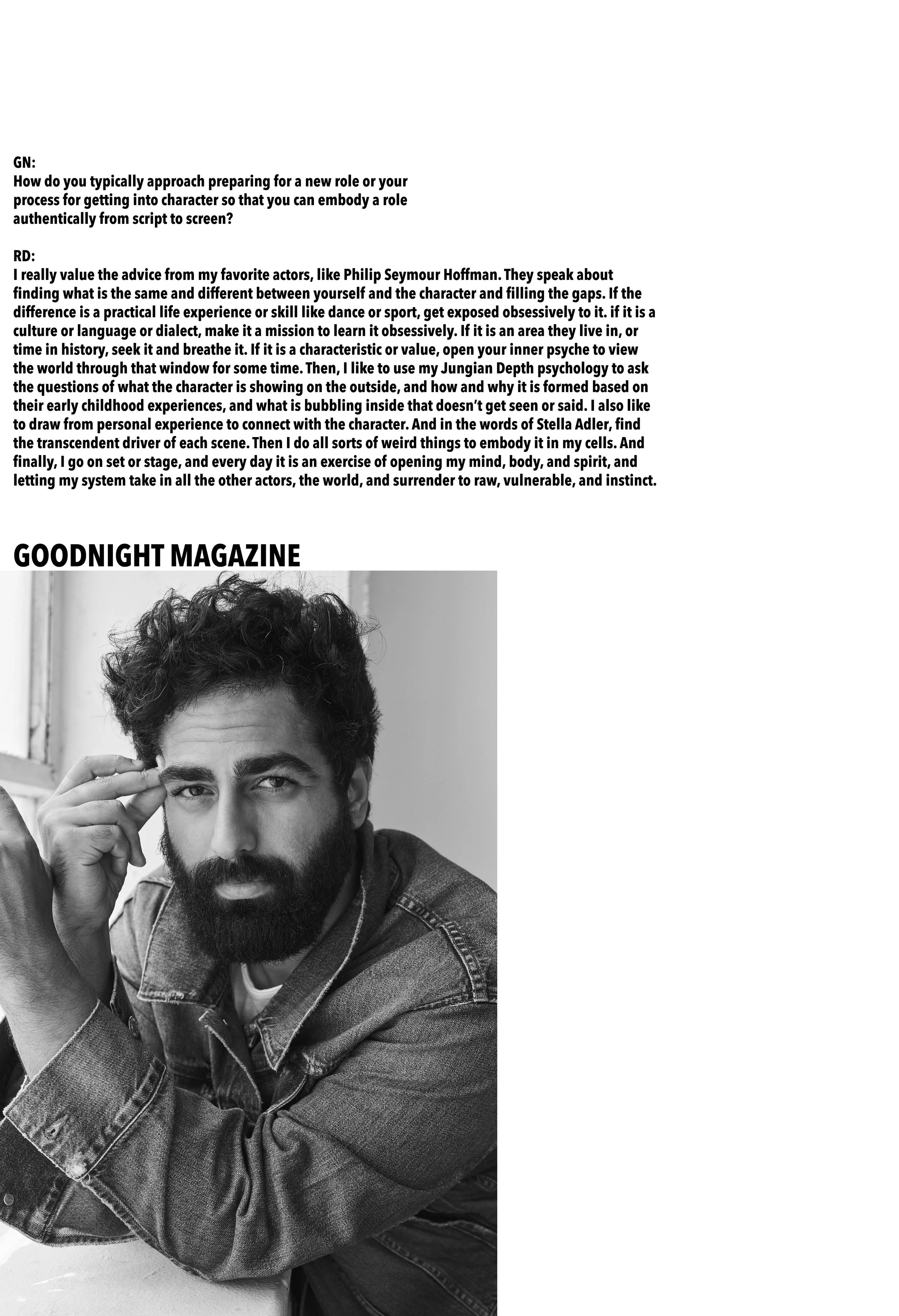
GN: How do you typically approach preparing for a new role or your process for getting into character so that you can embody a role authentically from script to screen?
RD: I really value the advice from my favorite actors, like Philip Seymour Hoffman. They speak about finding what is the same and different between yourself and the character and filling the gaps. If the difference is a practical life experience or skill like dance or sport, get exposed obsessively to it. if it is a culture or language or dialect, make it a mission to learn it obsessively. If it is an area they live in, or time in history, seek it and breathe it. If it is a characteristic or value, open your inner psyche to view the world through that window for some time. Then, I like to use my Jungian Depth psychology to ask the questions of what the character is showing on the outside, and how and why it is formed based on their early childhood experiences, and what is bubbling inside that doesn’t get seen or said. I also like to draw from personal to connect with the character. And in words of Stella Adler, find the transcendent driver of each scene. Then I do all sorts of weird things to embody it in my cells. And finally, I go on set or stage, and every day it is an exercise of opening my mind, body, and spirit, and letting my system take in all the other actors, the world, and surrender to raw, vulnerable, and instinct.
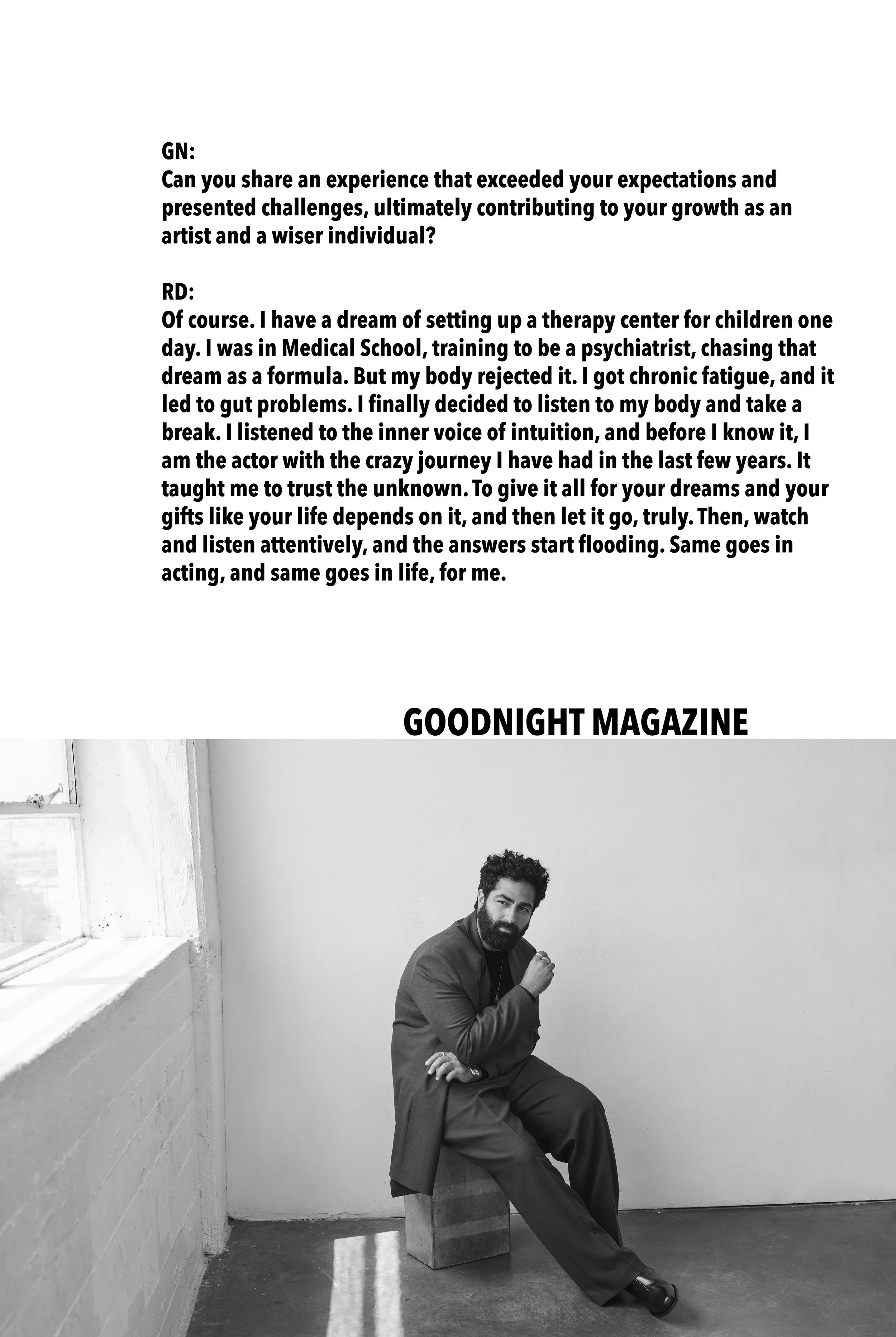
GN: Can you share an experience that exceeded your expectations and presented challenges, ultimately contributing to your growth as an artist and a wiser individual?
RD: Of course. I have a dream of setting up a therapy center for children one day. I was in Medical School, training to be a psychiatrist, chasing that dream as a formula. But my body rejected it. I got chronic fatigue, and it led to gut problems. I finally decided to listen to my body and take a break. I listened to the inner voice of intuition, and before I know it, I am the actor with the crazy journey I have had in the last few years. It taught me to trust the unknown. To give it all for your dreams and your gifts like your life depends on it, and then let it go, truly. Then, watch and listen attentively, and the answers start flooding. Same goes in acting, and same goes in life, for me.
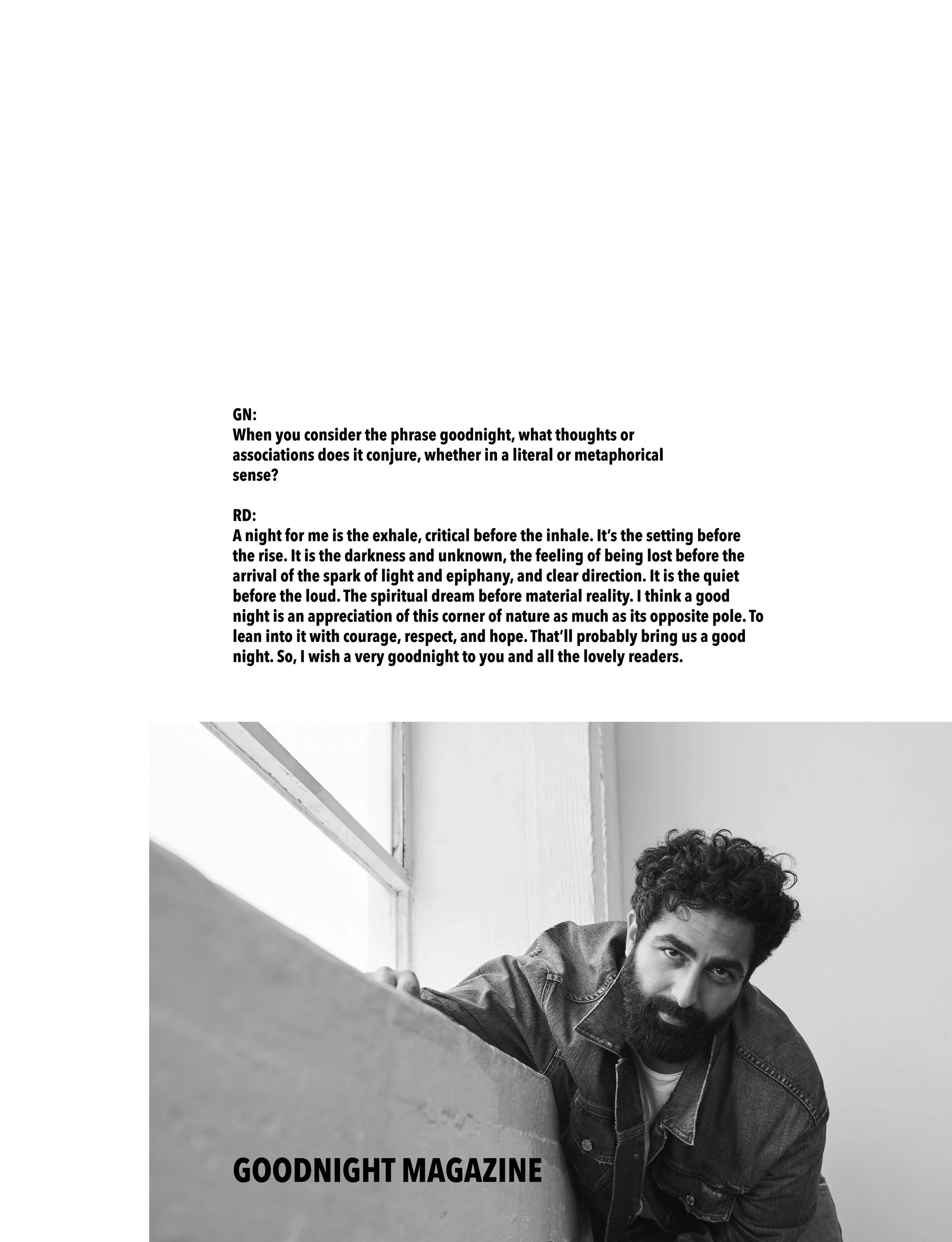
GN: When you consider the phrase goodnight, what thoughts or associations does it conjure, whether in a literal or metaphorical sense?
RD: A night for me is the exhale, critical before the inhale. It’s the setting before the rise. It is the darkness and unknown, the feeling of being lost before the arrival of the spark of light and epiphany, and clear direction. It is the quiet before the loud. The spiritual dream before material real. I think a good night, is an appreciation of this corner of nature as much as its opposite pole. To lean into it with courage, respect, and hope. That’ll probably bring us a good night. So, I wish a very goodnight to you and all the lovely readers.
Photographer: David Higgs
Stylist: Emily Bogner
Groomer: Colleen Dominique